Posts

The Gospel in a Sand Dollar

Image
I wasn’t looking for a sermon that morning—just shells. Beachcombing has always been that way for me—a gentle gathering, not just of shells, but of thoughts, memories, and sometimes…truth. That’s when I saw it. A sand dollar, half-buried in the wet sand, its edges worn smooth by time and tide. Not perfect. Not pristine. But still beautiful. I picked it up carefully, brushing away the grains clinging to its surface. And there it was—that familiar star etched across the top. I had heard the story before. The sand dollar and the Gospel. But that morning, it felt different.  Personal. Because isn’t that how God so often speaks? Not in grand gestures, but in quiet reminders we almost miss. The star made me think of Bethlehem—the beginning of everything. A promise fulfilled in the most unexpected way. Then I noticed the tiny openings, five in all. The symbolism came rushing back: the wounds of Christ. A story of suffering I’ve come to understand in deeper ways over the years. Pain has a ...

Shell Shadow Boxes

Image
If you’ve ever walked the shoreline with a bucket in one hand and hope in the other, you know how quickly seashells multiply. They start as treasures… and somehow end up tucked in drawers, filling glass jars, or sitting in bowls on the coffee table.  Sound familiar?  For years, I did the same thing. I couldn’t bear to part with the shells I’d collected—each one holding a memory of a sunrise walk, a quiet prayer, or laughter with family. But I also didn’t want them hidden away. Then I discovered the simplest, most beautiful solution: shadow boxes.   A Simple Way to Showcase Your Shells   Shadow boxes turn your seashell collection into meaningful art. Instead of clutter, you create a keepsake. Instead of storage, you create a story. I purchase my shadow boxes on Amazon in a variety of sizes, but I especially love the 5x5-inch frames. They’re just right—not too big, not too small. Perfect for highlighting a special collection without overwhelming your wall space...

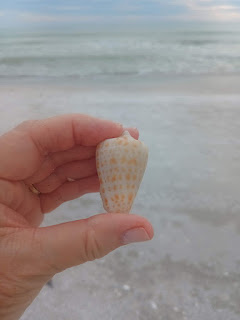
The Alphabet Cone

Image
  Alphabet Cone The Alphabet Cone is one of my personal favorites. It's fairly rare, but not as rare as the mighty Junonia. The one in the photo came rolling in with a wave. You have to be quick when that happens. But when you make the capture, it's magical. Unlike the Junonia which lies deep in the ocean, the Alphabet Cone (Conus spurius) is typically found in shallow coastal water and also in sandy or muddy substrates near the shore.  It gets its name from the markings on the outside of the cone that resemble letters of the alphabet and punctuation marks. The colors range from yellow to dark brown. They have a hearty shell with a narrow opening. The ones that I've found have all been intact, which is always a treat.  Since they are not deep sea dwellers and prefer the shallow waters of the coastal area so they can find their prey, you need to exercise caution. They kill their prey by using a venomous harpoon-like tooth, which paralyzes them first. Their preferred prey a...

Welcome to Beachcombing Bliss

Image
Welcome to my new blog where I'm going to share my beachcombing adventures in and around Anna Maria Island, Florida . If you're not familiar with the island, we're located on the Gulf of Mexico (the western side of Florida), where the sand is white and the water is emerald green to turquoise -- depending on the time of year.  Egg casing and Lightning Whelk  Today I want to share with you about one of my favorite shells -- the lightning whelk. It starts from an egg casing (the creature and the shell) and can grow up to 16 inches long. As babies, before they break through their egg casing, they're called a protoconch .   Lightning whelks are unique in that they open on the left side -- most shells open from the right side. My favorite color is chocolate brown and I've collected them from the size of a pencil head eraser to about 16 inches.  Four different species can be found in Florida waters and they're all beautiful.  Whelks are carnivorous and they like t...